UPDATE 4/21/20 — Nintendo has announced a free update for “Animal Crossing: New Horizons” which will be released on Thursday. The update will feature new seasonal events (such as Earth Day and May Day), the return of merchants Leif and Redd, and the return of an art gallery to the museum. There will also be a Wedding Season event where players will get to see Reese and Cyrus, the owners of Re-Tail.
UPDATE 8/31/20 — During the summer, Nintendo released two free updates for “Animal Crossing: New Horizons: which were released on July 3 and July 30. These updates implemented diving, sea creatures, Pascal, mermaid and pirate furniture and clothing, fireworks shows, dreaming, and a data backup system.
UPDATE 10/15/21 — Nintendo has announced the last major free update to New Horizons. The update includes the return of Brewster and The Roost, Kapp’n, the Gyroids, Harriett and furniture items like the popular Froggy Chair. The update also includes new features, like increased storage capacity and exterior house upgrades, an open market on Harv’s Island which gives permanent locations to shopkeepers like Redd and Saharah, cooking and gardening, a total of ten ramps rather than the previous eight, and a tool that places permanent ladders on the island.
On March 20, 2020, Nintendo released “Animal Crossing: New Horizons,” the newest installment in the “Animal Crossing” series of video games. For those not in the know, “Animal Crossing” is a real-time social simulation game where you live in a town full of animal characters and complete tasks such as fishing, catching bugs, and digging up fossils. The first game, “Animal Crossing,” was released in Japan in 2001 and in the U.S. in 2002.
The series has five main games: “Animal Crossing” for the Nintendo 64 and Gamecube, “Animal Crossing: Wild World” for the Nintendo DS, “Animal Crossing: City Folk” for the Nintendo Wii, “Animal Crossing: New Leaf” for the Nintendo 3DS and now “Animal Crossing: New Horizons” for the Nintendo Switch. There are also three spin-off games: “Animal Crossing: Happy Home Designer” for the Nintendo 3DS, “Animal Crossing: Amiibo Festival” for the Wii U and “Animal Crossing: Pocket Camp” for mobile devices. The next most recent game, “Animal Crossing: New Leaf,” was released in 2012.
I’ve had my copy of “New Leaf” since 2018, and recently was able to get a copy of “New Horizons.” I’ve only completed a few days of the game so far, but through what I’ve seen so far and what I’ve read online about “New Horizons,” here’s the most notable changes from “New Leaf” and my opinions on these changes.

My house in “Animal Crossing: New Leaf” 
My house in “Animal Crossing: New Horizons”
First, the obvious differences. “New Horizons” is on a completely different platform from “New Leaf,” which brings its own advantages and disadvantages. Aside from the graphics on the Switch being absolutely beautiful, the Switch gives you more ways to play. With the Switch, you can plug the console into a television screen, or you can play in “Handheld Mode”, holding the whole console as usual. You can also record up to 30 seconds of footage on the Switch by holding down the square camera button located on the left joycon. Doing so records the last 30 seconds of gameplay in games that allow recording, meaning that if you do something cool in a game you can save the moment for prosperity. The 3DS can only take screenshots, and not all 3DS games allow for this.
The main and major drawback of the Switch is the current climate we live in. Everyone is off work or school and stuck home, and thus everyone seems to be buying up Switches like they’re toilet paper. There are also people and companies who will buy a bunch of Switches and then resell them for much greater the retail price. In my case, the retail price of a Nintendo Switch console with neon red and blue joycons is $299, but due to scarcity I wound up buying mine for $450 after shipping and tax. Switch Lites are easier to find and a bit cheaper as well, so if you’re willing to sacrifice the ability to detach the joycons and plug the switch into the TV, you should have an easier time getting your hands on one. In contrast, my Nintendo 2DS cost $79 and I got it at Walmart without much fuss.
Now then, onto the games. “New Horizons” has kept several features from “New Leaf”, such as online multiplayer, a customizable ID card for the player, allowing only one island/town per game, the presence of K.K. Slider and having weather in the game that matches the weather the player is experiencing in real life (provided you have the right location listed in your Switch and told the Nookings at the start of the game that you wanted the hemisphere your island is located in to match the hemisphere you live in).
There are also some things that have been updated since “New Leaf.” The Nookling twins, Timmy and Tommy, have more functionality, with Timmy Nook serving as shopkeeper in the early game. Rather than the museum being present on the island from day one, you have to get Tom Nook to invite Blathers, the museum curator, to the island by giving him five bugs or fish. The Custom Design system is now available from the start of the game, instead of having to unlock it from the Able Sisters, who are also no longer present on day one and must have their business earned and constructed by the player. In “New Leaf,” there were MEOW Coupons, where you could earn coupons by completing daily/weekly tasks and then exchange those coupons for furniture at Harvey’s campsite or for Bells (the game’s currency) at the Automatic Bell Dispenser. In “New Horizons,” these have been replaced by Nook Miles, which you can earn in a larger variety of ways than the four tasks for MEOW Coupons. Nook Miles can be exchanged for furniture, clothing, and Nook Miles Tickets at the ABD, and your first debt to Tom Nook must be paid in Nook Miles. While the exchange rate for MEOW Coupons was 3,000 Bells for every 1 MEOW Coupon, the exchange rate for Nook Miles is 3,000 Bells for every 500 Nook Miles.
Speaking of Harvey, in “New Leaf” he had a campsite where items could be purchased for MEOW Coupons and where NPCs can visit in RVs. Different NPCs appear each day, and you can talk to them and buy three items from their caravan using MEOW Coupons. In “New Horizons,” Harvey lives on an island of his own and runs Phototopia, where you can take photos with your fellow island-dwellers.

Harvey’s Campsite. Photo taken from my own game. 
Harvey’s island. Photo courtesy of GameWith.
In “New Leaf,” certain furniture items could be customized at Re-Tail, which also functioned as a second-hand store where items could be sold (usually for better prices than the Nooklings’ shops). Re-Tail is not present in “New Horizons,” so now you have to do the furniture customizing yourself at any workshop table (once you’ve bought the customization kit from the Nooklings, of course). UPDATE 10/15/21 — Re-Tail will be returning in the Nov. 5 update.

“New Leaf” had three characters who were exchanged for newer versions in “New Horizons” — Nat, who ran monthly Bug Off insect catching competitions; Chip, who ran monthly Fishing Tourneys; and Joan, who sold turnips that could then be resold for various prices at Re-Tail in what is known as the Stalk Market. These three characters were replaced by Flick, C.J., and Daisy Mae, respectively. The three new characters are either implied (in Flick and C.J.’s cases) or stated (in Daisy Mae’s case) to be descendants of the original three characters.

C.J. (left) and Flick. Photo courtesy of AllGamers. 
Daisy Mae. Photo courtesy of Giant Bomb.
As previously stated, musician K.K. Slider appears and performs in “New Horizons.” However, he now has three new songs you can ask him to play: “Drivin’,” “Animal City,” and “Farewell.” These songs were what played in Club LOL whenever a player requested an invalid song from K.K. Slider.
The last major update is the ability to customize your character freely. In past games, the player character only had one skin tone, and your appearance at the beginning of the game was decided through dialogue choices made before the start of the game proper. Any changes to face or hairstyle after that, in “New Leaf”’s case, had to be done through Shampoodle, which cost Bells to do (i.e. 3,000 Bells to get a new haircut and color).

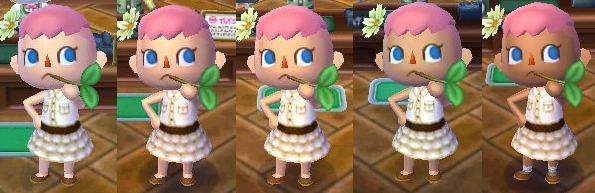
Previous games had a mechanic where, if your player character spends too much time in the sun during the summer months, they tan, and this tan can only be reversed by staying inside or using an umbrella while you’re outside. Interesting, but not great if you wanted to play as any normal skin color other than white. In “New Horizons,” you have complete control over your character from the beginning of the game. You can pick skin colors, hairstyles, eye colors and even mouth and nose shapes.
Also worth noting is that you’re no longer restricted by gender when you choose hairstyles. The game asks you to “choose your style,” presenting you with two gendered icons, but the choice doesn’t really change anything as far as I can tell, and you can change this “style” at any point in the game provided you have a mirror or vanity in your house. Honestly, the only thing the character customizer doesn’t have is eyebrows, and to get those you can just download a design through the Nintendo Switch Online app (more on this later).
One more thing — in “New Leaf” your neighbors will plop their houses down wherever they see fit, without a care in the world for the flowers or fruit trees you painstakingly kept there. In “New Horizons,” your neighbors will ask you for help setting up their tent, and you can either let them place their tents wherever or hand-pick their tent locations.
Unfortunately, with all the updates, there are things that we left behind in “New Leaf.” Tortimer Island (not to be confused with Tortimer‘s Island, a stage in “Super Smash Brothers”) is gone and with it goes the Kappa family. The Dream Suite, Club LOL and The Roost haven’t been mentioned yet. “New Leaf” town visitors such as Gracie, Redd and Katrina have also not been mentioned yet. It is unclear whether they will appear later or whether they are gone for good. UPDATE 4/21/20 — Redd will return to the game in an update released Thursday. He will appear on a boat called “Jolly Redd’s Treasure Trawler,” and players can enter this boat to buy artwork and furniture. This artwork can then be added to the new artwork wing of the museum, which will also be added in the same update. UPDATE 8/31/20 — An update was released on July 30 that implements Dream Addresses, a feature that can be accessed in The Dream Suite in “New Leaf.” Rather than going to The Dream Suite, players can sleep in their beds at home to access dreams. UPDATE 10/15/21 — Kapp’n (from the Kappa family), Katrina, and The Roost will be returning in the Nov. 5 update.
Two gameplay functions that have changed are the tools and the ability to reset. Tools in “New Horizons” now break after a certain number of uses, meaning you have to keep rebuilding these tools. In “New Leaf,” tools did not break, but you could gain upgrades though playing the game for long enough (for example, you get the Net from the Nooklings’ shop, you get the Silver Net by donating at least 30 insects to the museum and you get the Gold Net by completing your bug encyclopedia). These upgrades came with benefits, but you by no means HAD to obtain them all.

Resetting, meanwhile, has long been a topic of controversy in the “Animal Crossing” community. In previous installments of the series, if you didn’t like the way the game was going, you could quit without saving and start over, with the only consequence being that Mr. Resetti would show up and yell at you the next time you started the game up. However, since “New Horizons” autosaves, you can’t reset anymore. Because of this, Mr. Resetti now works for Rescue Services.
The last thing I want to mention is the lack of ability to play with friends over the internet for free. In order to visit the islands of other players in “New Horizons,” you must have a Nintendo Switch Online subscription, which costs $20 a year. Not too steep a cost, until you remember that in “New Leaf” you could visit other towns for free provided you had a working internet connection. The Nintendo Switch Online service also grants you access to an app, which allows you to scan QR code designs from “New Leaf” and chat with other players through text and voice chat, among other features. Helpful? Yes. Interesting? Yes. Worth $20 a year? I guess so. But after spending $450 on a Switch and $60 on the game, it rubs me the wrong way to have to pay a yearly subscription to do something I think should have been in the base game for free.
Finally, I’d like to talk about the completely new features that have been added to “New Horizons.” The Nintendo Switch Online service and corresponding app is one of them, and while I don’t like the payment part I do enjoy the concept of being able to use my real life smartphone to interact with my in-game Nook Phone. The Nook Phone is also a nice feature, which lets you check your Nook Miles progress, take pictures, call for Rescue Services, view crafting recipes, look at their encyclopedia, view or edit custom designs, chat with friends, and eventually shop from the phone. In “New Leaf” you would have had to go to several different buildings in the game to do all of these things, so having them all compressed into the phone makes things much more convenient.
The crafting system is also an interesting change. The only time such a system was referenced in the main series was in the “Desert Island Escape” minigame, which could be played in “New Leaf” if you had the Wii U furniture item and some Play Coins to spare. In this minigame, you could collect items such as rocks or sticks and turn them into tools you could use to collect food or fight off wild creatures. After a certain number of uses, these tools would break. I hate breakable tools as a concept, but I enjoy the fact that they took inspiration from the minigame for “New Horizons.”
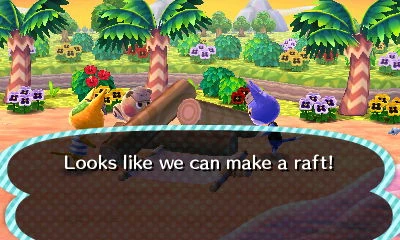
Aside from visiting friends, the Dodo Airlines facility in “New Horizons” allows you to visit randomized deserted islands for 2,000 Nook Miles a trip. This allows players to get rare fruit, creatures, and even villagers, the last of which can be invited back to the player’s home island. There are also several special islands, such as Tarantula/Scorpion Island (where the island is full of dangerous critters that can be captured and sold for a large amount of Bells) or the Money Rock Islands that are full of rocks that drop Bells when struck with an axe.
After you’ve upgraded your island enough, you unlock the ability to terraform. You can then create your own rivers, mountains, ponds, and waterfalls, allowing for an enormous amount of customization options.

The last thing I want to touch on here is the dev team’s communication with players. Through the use of their official Twitter account, the “New Horizons” development team offers advice about gameplay mechanics and encourages feedback from players. For example, April 1-12 this year was the Bunny Day event. For 12 days, players were able to obtain eggs by fishing, smashing rocks, digging, shooting down multicolored balloons, and shaking and chopping trees. These eggs can then be used to craft Bunny Day items. The only problem with this event was that, for 12 days of gameplay, very little else aside from eggs spawned, meaning players struggled to get resources that would normally be abundant. The Bunny Day event also overlapped with the Cherry Blossom event in the northern hemisphere, which ran from April 1-10, and the spring Fishing Tourney on April 11. The Bunny Day event made it harder for players to shake trees and capture cherry blossom petals needed to complete the Cherry Blossom line of items, and the overabundance of eggs appearing to be fish in the water made it harder for players to catch fish for the Fishing Tourney.
The dev team for “New Horizons” asked players on Twitter for feedback on their experience with the Bunny Day event, and players were more than happy to oblige. Whether the memes and feedback will influence next year’s Bunny Day remains to be seen, but at least they’re trying!
As the game continues to update and grow moving forward, there’s a lot I think players are hoping to see. Obviously characters like Brewster, Gracie, Redd, and all the other business owners are dearly missed, and hopefully they’ll get their time to shine on the island. I would really, really like to see Kapp’n and his family make an appearance again, because they were some of my favorite NPCs in “New Leaf.” I’d be interested to see how the Dream Suite would function if it were to appear in “New Horizons,” and getting Brewster’s and Club LOL back would be good as well. At the same time, “New Horizons” is just that — new. And while I can sit here all day and wish for old staples to come back, I’m also excited to see what new things might appear on my island as time goes on. Till then, I can just play both games with all the spare time I have on my hands.

Catching a sea anemone in “New Leaf.” 
Catching a sea bass in “New Horizons.”
At the end of the day, I think that if you’re a fan of the series and you’ve got a good amount of experience with “Animal Crossing,” “New Horizons” is a good addition to the series. If you’ve never played a game in the series before but want something to burn time, by all means give it a shot. It’s a beautiful game from a heartwarming series and I highly recommend it.
Categories: Opinion
I think the puns that pop up when you catch things were much funnier on New Leaf than New Horizons, and I don’t like the fact that there are no unbreakable tools in New Horizons. They could at least have made the gold tools unbreakable
That is a good tip particularly to those new to the blogosphere. Brief but very precise info… Many thanks for sharing this one. A must read article!